Caister beach
Welcome to the ENRG blogspot. We hope you enjoy reading about the bird ringing activities and experiences of the group.


Tuesday, 20 September 2011

Swallow Roost

At last the wind abated to give us an opportunity to try a Swallow roost at Martham Pits. 
Dave had checked the site on Wednesday night and had 70 to 100 birds go in, with this in mind we assembled on Thursday evening with fingers crossed hoping some would hang around.
It was fairly quiet at first with about 20 flying around the pits.The nets were checked early on in case anything had gone in unnoticed, 3 Reed Warblers and a Cettis were extracted.
 As the evening progressed the Swallows began to arrive, with about 70 flying about at one point.These were flying quite high and seemed to fly off East to roost somewhere else!
As we approached the nets the usual mutterings were said, ' no birds again',' why didn't they come down', ' should have been here last night ' .... etc. 
Luckily some had stayed and were ready to be extracted from the nets.


Adult male Swallow

In the end 37 Swallow were ringed with 23 1st year birds, 7 adult males and 7 adult females.
Also 3 Reed Warblers and a Cettis Warbler were newly ringed.

We went back to the comfort of Tony's to do the ringing and he also kindly supplied the refreshments.

Saturday, 10 September 2011

Chiff's on the move.

We arrived at Winterton just after dawn on Saturday 10th Sept, conditions were very muggy, complete cloud cover and a light SW getting fresher as the morning wore on, by the time we packed up it was a nice 21 degrees C.
As the nets were erected 2 or 3 Chiff's were heard calling, but not much else. Luckily we were in for a few more than that.  It was a good morning for Chiff's and Blackcaps with the added bonus of a juv Spotfly.


The first full grown Spotted Flycatcher we have ringed since 2001!

45 new birds were ringed, amazingly no retraps were caught.
Wren 1
Dunnock 1
Robin 2
Blackbird 1
Whitethroat 1, A late moulting adult.
Blackcap 13 ,  10 Males and 3 Females.  All juveniles apart from one.
Chiffchaff 17, 2 adults the rest juveniles.
Spotted Flycatcher 1
Long-tailed Tit 2
Blue Tit 4
Great Tit 1
Bullfinch 1, an adult female still with a brood patch.

Dave and friend.

A Swift was seen flying over and a Marsh Harrier flew South down the dunes.
Several Speckled Wood butterflies were still on the wing with numerous Common Darter's about, including the male that took a liking to Dave's hat! A Migrant Hawker was also seen.

Tuesday, 9 August 2011

Haddiscoe Island 2011

On Saturday evening Dave and Justin went to check out our reed bed ringing site on Haddiscoe Island. Rides were cut, nets erected and birds were caught. After ringing the small catch before darkness descended the team left well bitten by an army of mosquitos and midges.

Dave and Justin returned to the Haddiscoe Island reed bed to open the nets early on Sunday morning.

Birds quickly responded to the tape lures and Bearded Tits were soon heard 'pinging' around the net rides. The first round, however, consisted of juvenile Reed and Sedge Warblers with the Bearded Tits finding the nets later on. Most birds caught were juveniles but a few adults were nice to see including a fantastic male Bearded Tit.

 
Male Bearded Tits - Juv (left), Adult (right)

One juvenile Reed Warbler had a particularly warm rump and an unusually light eyes for a juv but any dreams of Blyth's were quickly dispelled with only the third primary being emarginated.

Juvenile Reed Warbler

Dave had a pleasant surprise when he pulled a juvenile Starling from the last bird bag of one round. Justin had seen a flock fly over the reed bed and finding two in a net he managed to extract them before Dave came along ensuring that their identity remained a secret. Both birds were juveniles in post-juvenile moult with one already having much greener feathers suggesting a probable male.

Juvenile Starlings

Despite the gusting wind it was a good catch with 62 new birds being trapped and 1 re-trap Reed Warbler having been originally ringed at the site in August 2007.

Sedge Warbler - 17
Reed Warbler - 26 (1)
Bearded Tit - 15
Starling - 2
Reed Bunting - 2

Saturday, 30 July 2011

House Martin 'RASing'

Over the last couple of weeks due to work commitments and the weather the only ringing we have managed has involved House Martins during some evenings.
Three sites have been visited, a new site at Hickling, with Horning Hall and Waxham being revisited for the second time this year.
The new site at Hickling involved 7 houses with an estimated 35 occupied nests, Dave had done the hard work and managed to get permission from all 7. 
21 new House Martins were caught together with a male House Sparrow that baled out of one of the nests.


Sharon explaining the niceties of flat flies!

At Horning Hall 19 were caught with 7 new and 12 retraps, these consisted of one from 2009 and 2010 and surprisingly one originally ringed on 31/07/2007.  This is our oldest House Martin to date.
Also the Barn Owl has produced 2 chicks, the Spot Fly is having a second brood in another box nearby and contains 3 eggs.
Also seen here on the river were 2 juvenile Bar Headed Geese! Soon to be a new feral species?

Juvenile House Martin.

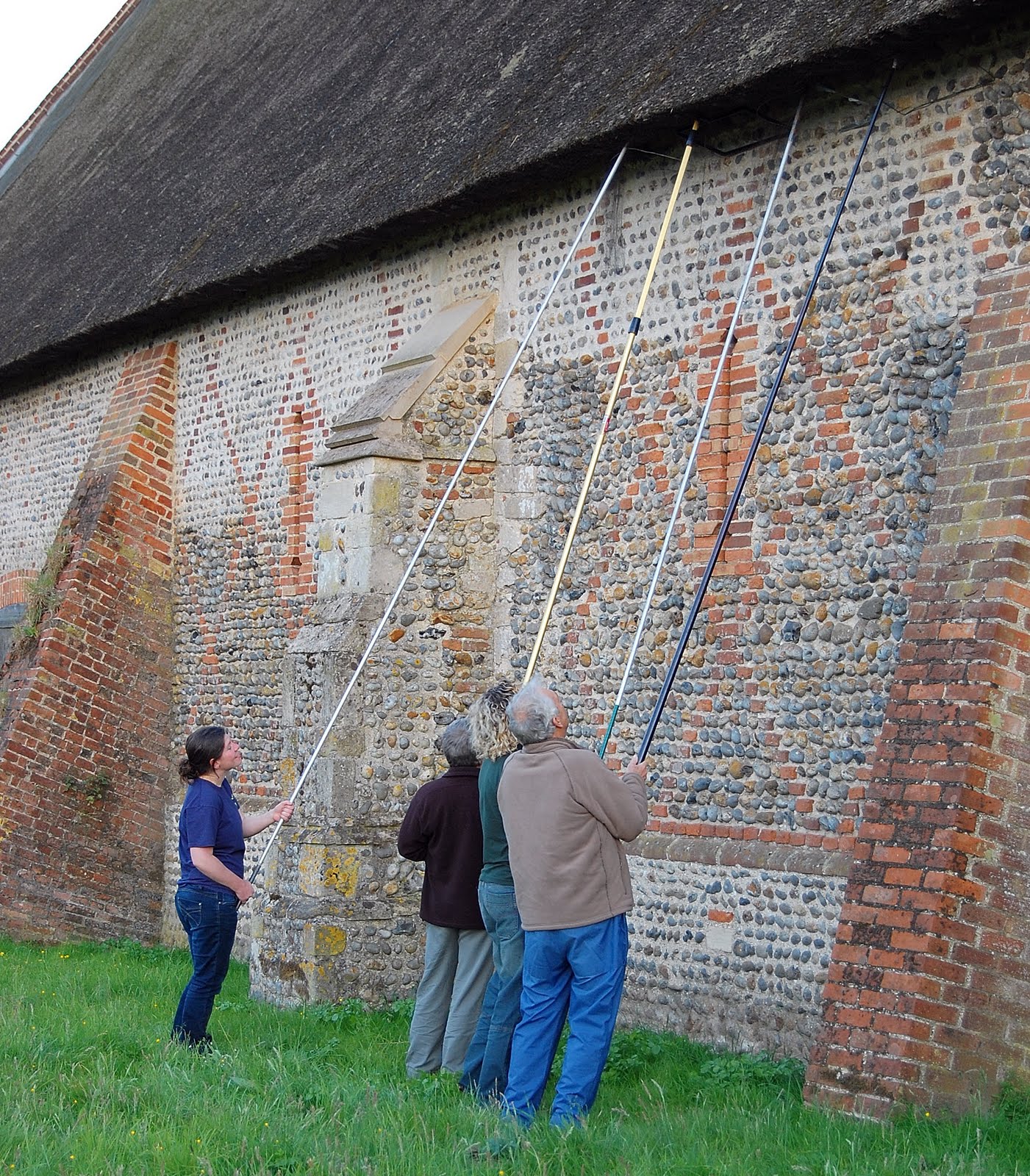
The second trip of the year to Waxham Great Barn proved a success with 38 being caught, 29 of which were new and 16 of these being juveniles. 5 of the 9 retraps were last years' birds.
For a brief spell Sharon equalled the record of 6 being caught at once but was eventually beaten by Gary later on in the evening when he netted 7!

Sharon and her half dozen, Dave thinking I've got to get this lot out!

This brings the grand total so far this year of 125 new birds, 30 retraps and 1 control.

On a more serious note, is this what Gary and Kev get up to in their spare time? No wonder ringing has been slack the last few weeks. 

Perhaps Kate can enlighten us. 

Saturday, 16 July 2011

Recent update

We have been fairly busy recently checking Barn Owls and doing some more House Martins.
Also a couple of trips to the new Little Tern colony at Caister. 


Little Terns bred at Caister for the first time last year with 3 pairs present, this year with the fragmentation of the Gt. Yarmouth colony about 40 pairs have settled to breed. They are again being looked after by the RSPB, who must be congratulated on doing such a sterling job.

Little Tern nest


Two visits have been made with 23 pulli ringed on the first trip and 9 new with 14 retraps on the second trip.
The retraps are very important for the ongoing 'growth rate' in sea birds survey being carried out. Also on the second trip a young Ring Plover was picked up. The colony was doing well up to a few days ago but the local Kestrels have now found them to their liking.

Little Tern pulli


Two recent Little Tern recoveries have come to light, both birds being originally ringed at the Gt. Yarmouth colony as chicks.
The first ringed 24th July 1998 and recaught 4695 days and 454km later, on 1st June 2011 at Point of Ayre on the Isle of Man.
The second ringed 29th June 2001 and the ring read in the field! 3618 days and 208km later on 26th May 2011 at Den Helder, Netherlands.
It would be interesting to know whether they are breeding in their new locations. 

Barn Owl pulli

Most of the Barn Owls have now been checked with only a couple left to return to. They have not faired very well, a lack of prey being the obvious reason. Some sites started well but have then gone on to only produce one chick! Out of 60 odd sites checked , prey (a House Mouse ) has only been present at one site, most of the pellets have been on the small side, indicating a lack of prey.
14 Adults have been caught with 4 retraps, 2 controls and 8 new and 23 new pulli. The largest brood being 5 chicks. This is well down on previous years.

Adult female Nightjar

A recent excursion to Winterton with Nightjars in mind  produced an adult female being ringed, unfortunately the male 'bounced'! At least 2 pairs were present. Luckily the local midges decided to stay away!!

The House Martin RAS scheme continues with another 2 sites, Caldecott and Filby each producing 9 new birds, 10 occupied nest's were at each site. This brings the total up to 65 new birds, 9 retraps and a control so far this year.


Friday, 24 June 2011

House Martin part 2

On Tuesday 21st we were out again, this time at Waxham Great Barn for part 2 of the RAS project.
There were several flying about when we arrived, with at least 80 birds flying around.
A quick count of the nests produced 11 at the front and 46 ! at the back, most looked occupied.


Some of the nests.

A Hobby came through and caused pandemonium for a brief spell, but they soon settled down. 
28 were caught with 23 new, 4 retraps all from last year and 1 control.
Dave has found out that the control, L568614 was originally ringed as a 3 (bird of the year) on 25th September 2010 at Icklesham, Sussex.

Sharon was chief catcher on the night with the aid of Dave's net.

Superb bird !

Also during the week the Spotted Flycatcher nest was revisited, fingers were crossed in the hope it had survived the recent downpours .
 When we arrived the adults were seen taking food in , so we knew at least something was there.

Spot Fly nest box

On inspection 4 pulli and 1 cold egg were found in the nest, so the chicks were duly ringed. There was no sign of the other Spot Flys that were present on the last visit.

Spot Fly pulli.

Friday, 17 June 2011

House Martins

This year we are catching House Martins for a RAS Study and need to catch around 100 birds ! Our first session was on Thursday 16th at Horning Hall, this has been a very productive site for this species for a number of years now.


Nets at the ready !

This technique was first shown to us a number of years ago by the late Sandy Hill, who was ' Mr.House Martin' . He had written several papers on the subject and also compiled the House Martin entry for the BTO Migration Atlas. A very knowledgeable and informative gentleman.

Adult House Martin
Adult House Martin

29 House Martins were caught, 24 were new and 5 retraps, 12 proved to be females and 17 males, no youngsters were caught.
Of the retraps 4 were originally ringed as adults in 2010, the other was ringed as a juvenile on 13/07/2009.
A very good start for the RAS project.

The business end.


The Spotted Flycatchers nest was checked and found to have 3 recently hatched chicks and 2 eggs, hopefully the weather won't put them off and should be ready to ring mid week.

On Wednesday night the lure of a 1st. Summer male Red Footed Falcon at Horsey proved irresistible. It was present at the beach end of the Nelson Head track and was seen hawking for Dragonflies over the fields.
Also present in the same area was a Hobby doing the same thing.

I need to win the lottery to get a bigger lens !

1st. Summer male Red Footed Falcon doing what it does best, catching Dragonflies.

Its still present at the moment, Friday, but maybe finding it hard to catch Dragonflies in the rain and strong winds we are now getting !